 Image 1 of 2
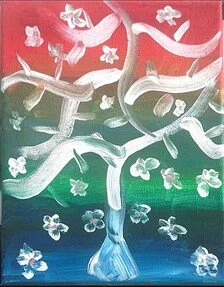 Image 2 of 2
Aquarelle painting of a solitary tree captured in two seasons: summer and winter.
Summer scene:
Warm, translucent washes of sap green, lemon yellow, and viridian build the leafy canopy with loose, layered strokes that allow the paper’s brightness to glow through.
The trunk and branches are rendered with diluted burnt umber and sepia, using dry brush textures to suggest rough bark and sun-dappled highlights.
Foreground grasses are suggested with quick, vertical strokes in olive and yellow ochre, with occasional wet-on-wet blooms to imply soft, sunlit edges.
Sunset sky: a luminous gradient from warm coral near the horizon to soft lavender higher up; wet-on-wet technique creates seamless, feathered transitions and a few glowing cloud edges.
Reflected warm light subtly kisses the tree’s sun-facing foliage and trunk, using pale washes of cadmium orange and pink to integrate the tree with the sky.
Winter scene:
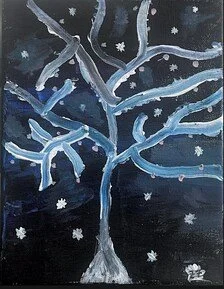
The same tree, leafless, is outlined with more defined, expressive branches in cool umber and Payne’s gray; controlled lifting and negative painting preserve delicate branch silhouettes.
Snow in the background and on the ground is suggested through cool washes of ultramarine mixed with a touch of violet and neutral tint, leaving the paper’s white for the brightest highlights. Soft blue shadows under the tree convey cold and depth.
Sunset sky: a crisp, clear gradient from icy rose near the horizon to deep indigo above, achieved with layered glazes to keep colors luminous yet cool. A few crisp cloud edges may carry faint peach tones to echo the setting sun.
Snow on branches is indicated with careful negative space and light scumbles of cool gray to suggest accumulation without obscuring branch structure.
Overall contrast is higher than the summer version to accentuate the stark silhouette against the snowy background and the crisp, cold light of sunset.
Composition and technique notes:
Maintain consistent framing and viewpoint so the tree reads as the same specimen across seasons.
Use wet-on-wet for skies to achieve soft transitions; employ wet-on-dry and dry brush for branch and bark details.
Control pigment granulation and glazing to balance translucency with structural definition.
Preserve white paper strategically for snow highlights and sunlit foliage rather than applying heavy opaque whites.
Aim for atmospheric cohesion by repeating a few color notes (a hint of warm peach or cool violet) across both paintings so they read as a paired study.
Aquarelle painting of a solitary tree captured in two seasons: summer and winter.
Summer scene:
Warm, translucent washes of sap green, lemon yellow, and viridian build the leafy canopy with loose, layered strokes that allow the paper’s brightness to glow through.
The trunk and branches are rendered with diluted burnt umber and sepia, using dry brush textures to suggest rough bark and sun-dappled highlights.
Foreground grasses are suggested with quick, vertical strokes in olive and yellow ochre, with occasional wet-on-wet blooms to imply soft, sunlit edges.
Sunset sky: a luminous gradient from warm coral near the horizon to soft lavender higher up; wet-on-wet technique creates seamless, feathered transitions and a few glowing cloud edges.
Reflected warm light subtly kisses the tree’s sun-facing foliage and trunk, using pale washes of cadmium orange and pink to integrate the tree with the sky.
Winter scene:
The same tree, leafless, is outlined with more defined, expressive branches in cool umber and Payne’s gray; controlled lifting and negative painting preserve delicate branch silhouettes.
Snow in the background and on the ground is suggested through cool washes of ultramarine mixed with a touch of violet and neutral tint, leaving the paper’s white for the brightest highlights. Soft blue shadows under the tree convey cold and depth.
Sunset sky: a crisp, clear gradient from icy rose near the horizon to deep indigo above, achieved with layered glazes to keep colors luminous yet cool. A few crisp cloud edges may carry faint peach tones to echo the setting sun.
Snow on branches is indicated with careful negative space and light scumbles of cool gray to suggest accumulation without obscuring branch structure.
Overall contrast is higher than the summer version to accentuate the stark silhouette against the snowy background and the crisp, cold light of sunset.
Composition and technique notes:
Maintain consistent framing and viewpoint so the tree reads as the same specimen across seasons.
Use wet-on-wet for skies to achieve soft transitions; employ wet-on-dry and dry brush for branch and bark details.
Control pigment granulation and glazing to balance translucency with structural definition.
Preserve white paper strategically for snow highlights and sunlit foliage rather than applying heavy opaque whites.
Aim for atmospheric cohesion by repeating a few color notes (a hint of warm peach or cool violet) across both paintings so they read as a paired study.